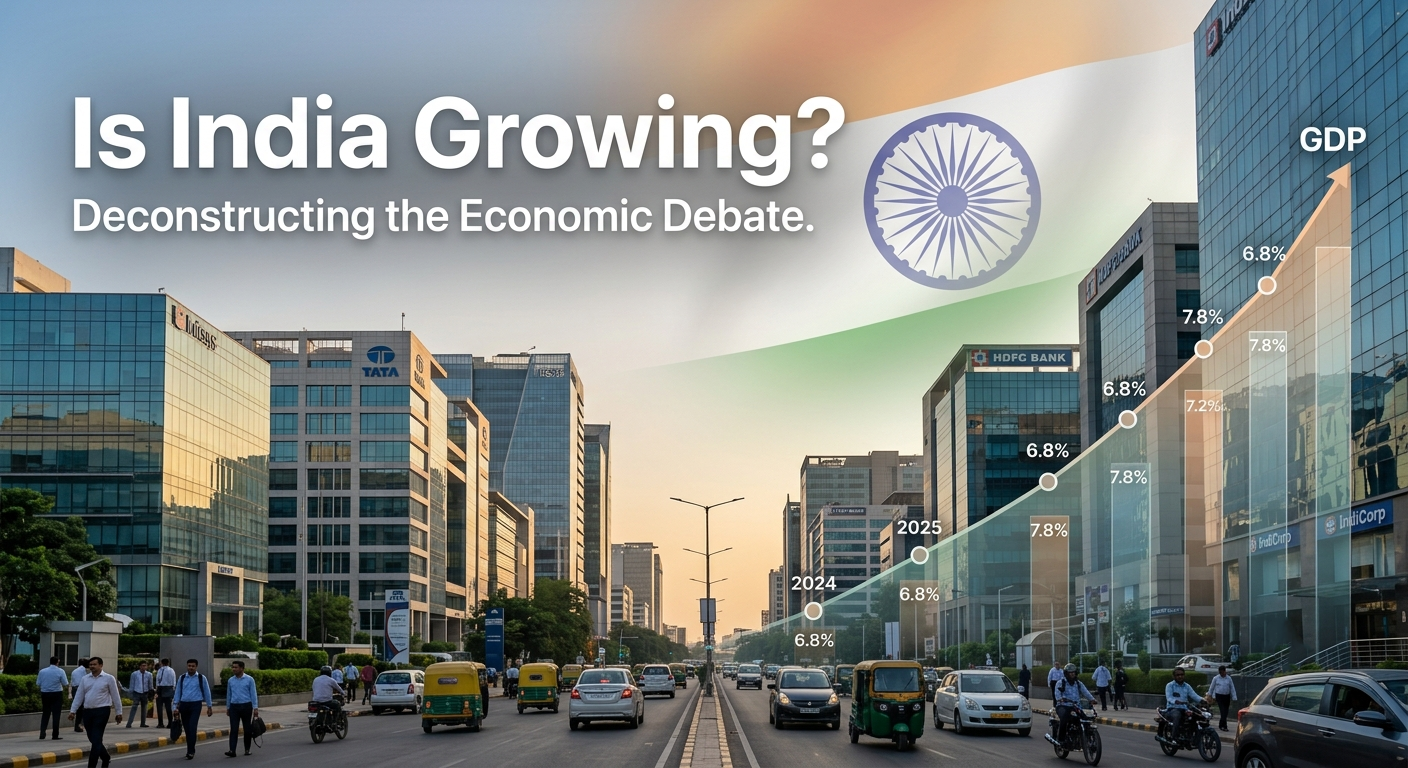
The Indian economy continues to demonstrate remarkable resilience amidst global uncertainty, yet a major debate has recently erupted over the country's first-quarter GDP numbers.
One expert recently suggested that India’s real GDP growth was a mere 2.6%, sharply contrasting with the government’s reported 7.8%. Taking it a step further, they argued that after adjusting for inflation, the economy registered virtually no real growth. Unsurprisingly, this sparked a heated debate.
My perspective on this is straightforward: we must approach the data logically, not emotionally.
Is there any concrete reason to believe the 7.8% growth figure is unrealistic? The short answer is no. Let’s look at the underlying indicators:
- Direct tax collections (based on data up to August 10) show robust growth of around 23%.
- Monthly GST collections consistently hover near ₹2 lakh crore, compounding at a double-digit rate.
- Corporate earnings, specifically India Inc.’s topline growth, posted a healthy 20% year-on-year increase in the June quarter.
- Automobile sales, spanning both two-wheelers and passenger vehicles, continue to surge.
When businesses are expanding, tax receipts are surging, and consumer spending remains strong, it is incredibly difficult to accept the premise of zero real growth.
This is not to say GDP numbers are immune to revision; they can and will be updated. Much of the recent confusion stems from India shifting its base year for GDP calculation from 2011-12 to 2022-23. The methodology has also evolved, notably incorporating a double deflator to better account for the spread between the WPI and CPI. When previous-quarter figures are revised under this new framework, comparing a single, isolated metric against an older estimate paints a distorted picture.
Another prevailing argument suggests that India’s equity market is stagnating because underlying economic growth is weak. Some experts are even using this skepticism around GDP to explain the market's sideways movement over the past two years.
I strongly disagree. The idea that GDP growth and stock market performance must move in lockstep in the short term is a persistent myth. While they align over the long haul, their short-term behaviors can diverge significantly.
Consider a few global examples:
- The United States: In 2023, the US economy grew by 2.9%, while the S&P 500 delivered a 24% return. In 2024, GDP growth slowed marginally to 2.8%, yet the index returned another 23%.
- South Korea: In 2025, economic growth nearly halved—dropping to 1% from 2% the previous year—yet the KOSPI delivered a spectacular 76% return.
- Pakistan: Despite the economy struggling to surpass a 3.7% growth rate over the past three years, its equity market impressively generated returns exceeding 50% in each of those corresponding financial years.
The takeaway isn't that GDP doesn't matter; it matters enormously over the long term. However, markets do not simply price in today’s GDP—they discount future expectations. Therefore, using short-term market performance to validate or invalidate current GDP growth is a fundamentally flawed investment argument.
As an investor and fund manager, my focus lies elsewhere. I don’t spend my time agonizing over whether growth is exactly 7.8% or 6.8%. Instead, I ask three fundamental questions:
- Are valuations reasonable?
- Is India Inc. actually growing?
- Crucially, is that growth sustainable?
Right now, India checks all three boxes.
The most prominent factor weighing on this sentiment is crude oil. The ongoing Middle East conflict has reignited fears of crude prices marching back toward $100 a barrel. For a heavily import-dependent country like India, this is no minor headwind. India’s net oil and gas import bill stood at $116.4 billion in FY2026. Within just the first four months of the current year, it has already hit $57.8 billion. Annualized, this could balloon to roughly $173 billion. If anything can swiftly sour India’s market sentiment, it is crude oil.
The other major market narrative is Artificial Intelligence. The concern here isn't the fundamental business opportunity—AI is transformative and very real. The concern is valuation. Is the optimism already fully priced in? The ideal time to enter a sector isn't during peak euphoria; it is when there are a hundred reasons to avoid it. Today, most of the good news surrounding AI is already baked into current prices, meaning future returns may not come as easily.
Interestingly, foreign portfolio investors (FPIs) are warming up to India again, despite the absence of a dominant local AI narrative. FPIs have been net buyers for the past two months. If this trend holds, retail investors will inevitably take notice. Capital flows where sentiment shifts, and retail money historically follows institutional leads.
The Indian market has traded sideways for nearly two years, understandably breeding frustration and negativity among investors. Yet, the outlook remains firmly bullish. This isn't rooted in home bias, but in tangible shifts occurring within the broader economy. Corporate earnings are improving, consumption is healthy, tax collections are robust, and the banking system is in its best shape in years. Liquidity is easing, and global investors are beginning to view India through a new lens.
There will always be a wall of worry to climb—today it's crude oil; tomorrow it might be geopolitics, the US economy, or AI. But markets don't generate wealth in the absence of risk. They generate wealth when risks are widely known and largely priced in, leaving the upside potential unrecognized.
That is exactly where the Indian market stands today. The downside risk in equities is relatively limited, while the upside potential remains substantial. For a patient investor, that is a compelling proposition worth staying the course for.
Loading comments...